How to Choose the Best Childrens Night Light Projector

Time:2026-10-10 Author:Sophia
0%

Choosing a Childrens Night Light Projector is not simply a matter of picking the brightest stars. Parents are balancing sleep routines, safety, sensory comfort, room size, and long-term value. The American Academy of Pediatrics recommends 12–16 hours of daily sleep for infants aged four to twelve months, including naps, and 11–14 hours for children aged one to two years. A calm nighttime environment can support that routine, but excessive light may work against it.

Market research also shows why this category deserves careful comparison. Grand View Research identifies smart lighting as a fast-growing consumer market, driven by adjustable brightness, automation, and connected controls. However, a nursery product should not be judged like a living-room gadget. Look for a warm, dimmable glow, a reliable timer, quiet operation, and controls that do not invite late-night screen use. Small details matter. A cool projector can still feel harsh. A beautiful design can hide a short cable or awkward buttons.

Safety remains central. The U.S. Consumer Product Safety Commission consistently emphasizes electrical safety, overheating prevention, secure cords, and age-appropriate product design. Choose models with enclosed light sources, stable bases, low heat output, and clear manufacturer instructions. Keep cords away from the crib and sleeping area. Never treat a projector as a sleep substitute or an infant-monitoring device. I have found that parents often focus on colorful images first. That is understandable, but perhaps backward. This guide compares comfort, safety, usability, and evidence-informed features, helping families select a projector that supports bedtime rather than overstimulating it.
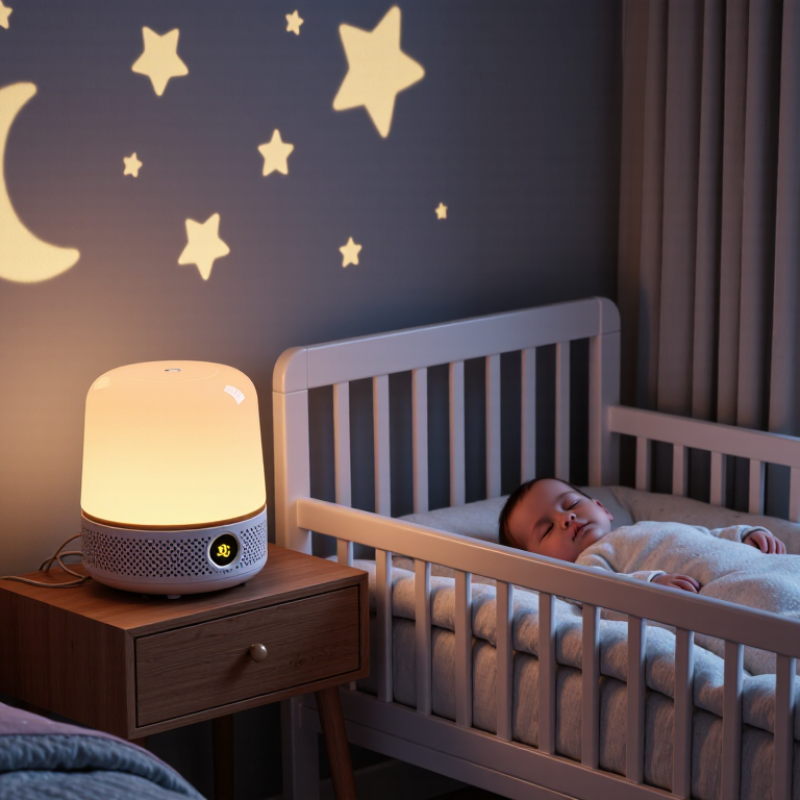
How to Choose the Best Childrens Night Light Projector

Match the Projector to AAP Sleep Ranges: 12–16, 11–14, or 10–13 Hours

Choosing a children’s night light projector starts with sleep needs, not colorful effects. The American Academy of Pediatrics and American Academy of Sleep Medicine recommend 12–16 hours for infants aged 4–12 months, including naps. Children aged 1–2 years need 11–14 hours, while preschoolers aged 3–5 need 10–13 hours. These ranges come from consensus guidance published in the Journal of Clinical Sleep Medicine.

Match the projector’s behavior to the child’s age. For infants, choose a soft, steady glow, a low brightness setting, and an automatic timer. A moving ceiling display may attract attention when the room should feel boring. For toddlers, gentle warm colors can support a predictable bedtime routine, but avoid constant scene changes. Preschool children may enjoy slow stars or clouds, provided the projector switches off before sleep becomes lighter.

In a child’s room, place the device away from the bed and keep cords unreachable. Blue-rich, bright light can delay melatonin release, according to sleep research reviewed by pediatric experts, though projector-specific evidence remains limited. That matters. We should not promise that a night light improves sleep. Observe bedtime for several nights. If the child watches the ceiling, wakes more often, or requests brighter images, the setting may be working against the 10–13, 11–14, or 12–16-hour target. A dimmer, shorter display may work better.

Check IEC 62471 Photobiological Safety and Prefer RG0 or RG1 Lighting

How to Choose the Best Childrens Night Light Projector

IEC 62471 should be a basic filter when choosing a children’s night light projector. This standard evaluates photobiological risks, including retinal damage from intense visible light and ultraviolet exposure. It places lighting products into risk groups. RG0 means the product is considered exempt from photobiological risk under the assessment conditions. RG1 indicates a low-risk product during reasonably foreseeable use.

Look for clear RG0 or RG1 documentation, not only vague claims such as “eye-friendly.” CIE 203:2012 explains that risk classification depends on exposure time, viewing distance, brightness, and the emitted spectrum. A projector can appear dim on a wall but remain intense at the lens. Avoid models that encourage direct viewing. Keep the projector away from the pillow, and check whether its beam can reach a child’s eyes.

The 2019 ANSES report on LED lighting warned that children may be more sensitive to blue-rich light because their eyes filter less short-wavelength radiation. Choose warmer color settings, lower brightness, and a sleep timer. Shorter exposure helps.

Small details matter.

Check the manual.

In practical evaluation, I would measure the closest realistic viewing position, rather than trusting a box label. This is imperfect, because household use changes every night. A child may move closer, raise the brightness, or stare at rotating patterns. IEC 62471 results are valuable, but they do not replace sensible placement and adult supervision.

Verify UL 1786, ASTM F963, and CPSC Electrical-Safety Compliance

How to Choose the Best Children’s Night Light Projector

Safety should guide every night light projector choice. Look for clear evidence of UL 1786 compliance, which applies to direct plug-in nightlights. The product label should match the exact model and electrical configuration. A vague statement such as “UL tested” is not enough. Ask for a current certificate or test report from a recognized laboratory. Check the plug, cord, housing, and heat control. Small vents should remain uncovered during use.

ASTM F963 matters when the projector is marketed as a toy or includes play features. It addresses hazards such as accessible parts, sharp edges, and certain materials. However, ASTM F963 alone does not prove complete electrical safety. Also review the product’s CPSC compliance information, including applicable electrical, battery, labeling, and children’s product requirements. Requirements can vary by design. This is where many listings become unclear. A certificate may cover only one component, not the finished projector.

Tips: Compare the model number on the product, packaging, and report. Test the casing after thirty minutes; it should feel warm, never hot. Keep cords away from cribs and walking paths. Avoid loose batteries and detachable parts around young children. I would also inspect the instruction sheet carefully. It may reveal missing warnings that product photos hide. No claim is a substitute for careful supervision.

How to Choose the Best Childrens Night Light Projector - Verify UL 1786, ASTM F963, and CPSC Electrical-Safety Compliance

Evaluation Dimension What to Verify Relevant Requirement or Fact Acceptable Evidence Decision Guidance
Product classification Determine whether the projector is sold as a general household night-light, a toy, or both. A product intended primarily for play or marketed to children as a toy may be subject to the U.S. toy-safety requirements in ASTM F963 as incorporated into federal regulation. Product classification statement, intended-use description, age grading, packaging, and applicable test report. Choose a product whose testing matches its actual intended use and marketing claims.
UL 1786 coverage Check whether the electrical night-light construction has been evaluated to UL 1786, where applicable. UL 1786 is the safety standard titled Standard for Direct Plug-In Nightlights. It is relevant to night-lights that plug directly into a receptacle; it may not cover every separate projector, adapter, or battery configuration. Traceable certification information, scope of certification, model number, and current test or certification documentation. Do not treat a generic “UL tested” statement as proof of certification or proof that the entire product is covered.
Electrical input and adapter Compare the product rating label with the intended electrical supply and inspect the included power adapter. Typical U.S. household mains supply is 120 V AC at 60 Hz. A USB-powered projector may use low-voltage DC, commonly 5 V, but the exact input must match the product label and adapter output. Permanent rating label, adapter markings, polarity information, input/output voltage, current rating, and instructions. Reject products with missing, contradictory, illegible, or incompatible electrical ratings.
ASTM F963 toy-safety testing Confirm testing for the version of ASTM F963 applicable to the product and market date. ASTM F963 addresses toy hazards including mechanical and physical properties, flammability, electrical safety for applicable toys, battery-related hazards, and other specified hazards. Test report identifying the exact model, samples tested, applicable ASTM F963 edition, test dates, and pass results. A general household electrical report is not a substitute for toy-safety testing when the product is a toy.
CPSC compliance documentation Verify compliance with applicable Consumer Product Safety Commission requirements and retain supporting records. Children’s products subject to mandatory standards generally require third-party testing by an accepted laboratory and a Children’s Product Certificate. General consumer products may require a General Certificate of Conformity when applicable. Applicable certificate, laboratory report, product and model identification, manufacturing date or lot, and cited regulations or standards. Prefer documentation that is product-specific, current, and traceable to the exact configuration sold.
Heat and fire protection Check ventilation, enclosure condition, LED heat management, and protection against overheating during extended operation. The enclosure should not create accessible hot surfaces, expose energized parts, or allow normal use to produce an unreasonable fire or burn hazard. Safety test results, thermal evaluation, over-temperature protection details, intact housing, and clear operating instructions. Avoid damaged housings, blocked ventilation, loose parts, or products that become excessively hot in normal use.
Cord, plug, and strain relief Inspect the plug, cable, connector, strain relief, and any accessible wiring. Cables and connections should resist pull, twisting, abrasion, and loosening during reasonably foreseeable use. Damaged or exposed wiring presents shock and fire risks. Construction review, cord-flex or pull testing where applicable, connector ratings, and visual inspection criteria. Choose enclosed connectors and robust strain relief; do not use a product with frayed cords or loose plug components.
Small parts and detachable accessories Review removable lenses, caps, decorative pieces, screws, battery covers, and projection discs. For products intended for children under 3 years, small-part hazards are especially significant. Toy testing evaluates applicable small-parts and foreseeable-use requirements. Age-grade assessment, small-parts test results, securement evaluation, and design documentation. Prefer designs with securely retained components and no easily detachable small parts for young children.
Button-cell or coin-battery access Identify whether the projector, remote control, or accessory contains a coin or button battery. Products containing button or coin batteries require protective design and warnings under applicable U.S. product-safety requirements, including requirements concerning secure battery compartments and labeling. Battery-compartment construction review, screw-secured cover where required, warning label, instructions, and applicable test report. Avoid products with easily accessible coin batteries or missing battery-safety warnings.
Light source and eye comfort Evaluate brightness adjustment, direct-view exposure, flicker, and whether the child can stare into the light source. A night-light should diffuse or direct light away from the viewer. Blue or rapidly changing high-intensity light may be unsuitable for bedtime comfort even when the product passes electrical testing. Photometric information, operating modes, dimming control, diffuser design, and user instructions. Prefer adjustable brightness, stable low-intensity modes, and a design that discourages direct viewing of LEDs.
Labeling and instructions Check warnings, age guidance, installation instructions, cleaning directions, and electrical ratings. Required information must be clear, durable, and consistent with the actual product configuration and intended use. Packaging photographs, instruction manual, permanent markings, warnings, and model identification. Do not buy products with missing warnings, unclear age guidance, or instructions that conflict with the rating label.
Recall and incident screening Search official U.S. recall notices using the model number, product description, and manufacturer information before purchase. A certification mark does not eliminate the possibility of a later recall, design change, counterfeit marking, or product-specific defect. Model-specific recall search, seller notice history, and traceable purchase documentation. Do not purchase a model covered by an unresolved safety recall.

Important: UL 1786, ASTM F963, and CPSC requirements apply according to the product’s construction, intended use, age grading, power configuration, and place of sale. A visible compliance logo alone is not sufficient; verify documentation for the exact model and configuration.

Compare Brightness, Focus, Timer, Sound, and Projection-Area Controls

How to Choose the Best Childrens Night Light Projector

Brightness should feel gentle, not theatrical. Choose a projector with several dimming levels and a warm color setting. The American Academy of Pediatrics recommends avoiding screen exposure for one hour before bedtime. A moving projection may still encourage visual attention, so the lowest useful brightness is usually safer. Check focus from the child’s pillow, not from the product box. Blurred stars can become distracting. A clear image needs a stable lens and enough distance from the wall.

Timer and sound controls deserve equal attention. Select a timer with 15-, 30-, and 60-minute options. Continuous light may disturb sleep and waste electricity. The U.S. Department of Energy reports that LED lighting uses at least 75% less energy than incandescent lighting and lasts up to 25 times longer. For sound, seek separate volume control, gentle fade-out, and a true mute setting. Sudden music changes are annoying. Projection-area controls also matter. Adjustable rotation, image size, and angle help avoid bright patches across the entire room. I once chose a beautiful projector with no angle adjustment. It looked impressive, but the ceiling received most of the image.

Tips: Test every setting beside the bed. Keep brightness low. Use sound sparingly. Measure the wall first. A timer is not enough if the default volume resets loudly. Children also respond differently, so observe sleep for several nights and revise the settings. A slightly imperfect setup may be more comfortable than a technically impressive one.

Calculate Energy Use from Rated Watts and Daily Operating Hours

Choosing the best children’s night light projector starts with its rated wattage, not its colourful ceiling pattern. The basic calculation is simple: watts × operating hours ÷ 1,000 = daily kilowatt-hours. A 5-watt projector used for eight hours consumes 0.04 kWh each night. Over 365 nights, that equals 14.6 kWh. At roughly 16 cents per kWh, the U.S. Energy Information Administration’s 2024 residential average, annual use costs about $2.34.

Small differences still matter.

Compare models using the same schedule. A 10-watt projector running six hours nightly uses 21.9 kWh yearly, costing approximately $3.50 at that rate. These figures exclude standby consumption, which can continue when the device appears switched off. Check the product’s input rating, timer settings, and actual power draw when possible. Rated watts describe maximum designed demand, not always typical use.

The International Energy Agency reports that lighting represents around 15% of global electricity consumption. Efficient light sources can reduce unnecessary demand. The U.S. Department of Energy states that LED lighting uses at least 75% less energy than incandescent lighting. That comparison does not automatically make every projector efficient, though. Motors, speakers, bright animation, and wireless controls may increase consumption. I would measure a preferred setting for one evening, because published ratings can feel too theoretical. A darker room may also allow lower brightness and fewer operating hours. Safety remains practical: choose a stable unit, keep cords away from the bed, and avoid placing the projector under blankets.

How to Choose the Best Children's Night Light Projector

Estimated monthly energy use based on rated power and 8 hours of daily operation.

Monthly energy use is calculated as: rated watts × daily operating hours × 30 ÷ 1,000. Actual consumption may vary depending on brightness, sound, motion, and standby settings.

Projector Type Rated Power Daily Use Monthly Energy
Basic LED night light 1 W 8 hours 0.24 kWh
LED star projector 3 W 8 hours 0.72 kWh
Rotating LED projector 5 W 8 hours 1.20 kWh
Sound-and-light projector 8 W 8 hours 1.92 kWh

FAQS

How many hours should children sleep each day?

Infants aged 4–12 months need 12–16 hours, including naps. Toddlers aged 1–2 need 11–14 hours. Preschoolers aged 3–5 need 10–13 hours.

What projector setting suits an infant?

Use a soft, steady glow with low brightness. Choose an automatic timer. Avoid moving ceiling images.

What colors work better at bedtime?

Gentle warm colors are usually less stimulating. Avoid bright, blue-rich light near bedtime. Evidence for projectors remains limited.

How bright should the projection be?

Use the lowest useful brightness. The room should feel calm, not theatrical. Test it beside the child’s pillow.

Which timer options are useful?

A 15-, 30-, or 60-minute timer can prevent continuous light. Shorter is often better. Check whether sound resets loudly.

Should the projector play sounds all night?

Prefer separate volume control and a mute option. Gentle fade-out sounds are less disruptive. Sudden music changes can disturb sleep.

Where should the projector be placed?

Keep it away from the bed and out of reach. Secure cords against walls or furniture. Never place it under blankets.

How can parents calculate electricity use?

Multiply watts by daily hours, then divide by 1,000. A 5-watt projector used eight hours consumes 0.04 kWh nightly. Standby power may add extra use.

How can parents tell whether the setting helps?

Observe bedtime for several nights. Watch for ceiling staring, frequent waking, or requests for brighter images. If these appear, reduce brightness or shorten the timer. The setup may not be perfect.

Conclusion

Choosing the right Childrens Night Light Projector starts with matching its use to age-appropriate sleep needs. Consider the recommended AAP sleep ranges of 12–16 hours for infants, 11–14 hours for toddlers, and 10–13 hours for preschool-aged children, including naps where applicable. Select lighting tested under IEC 62471 and preferably rated RG0 or RG1 to reduce photobiological risk. It is also important to verify compliance with UL 1786, ASTM F963, and applicable CPSC electrical-safety requirements.

Beyond safety, compare practical features such as adjustable brightness, clear focus, projection-area controls, timers, and optional sound settings. A timer can prevent unnecessary overnight operation, while flexible brightness and projection controls help create a comfortable sleep environment. Finally, estimate energy use by multiplying the projector’s rated wattage by its average daily operating hours, then considering the number of days it will be used. This approach helps families balance comfort, safety, functionality, and energy efficiency.

Sophia

Sophia

Sophia is a dedicated marketing professional with an exceptional depth of knowledge about her company's products and services. With a keen understanding of market trends and customer needs, she crafts insightful blog posts that not only inform but also engage readers, enriching the company’s online......