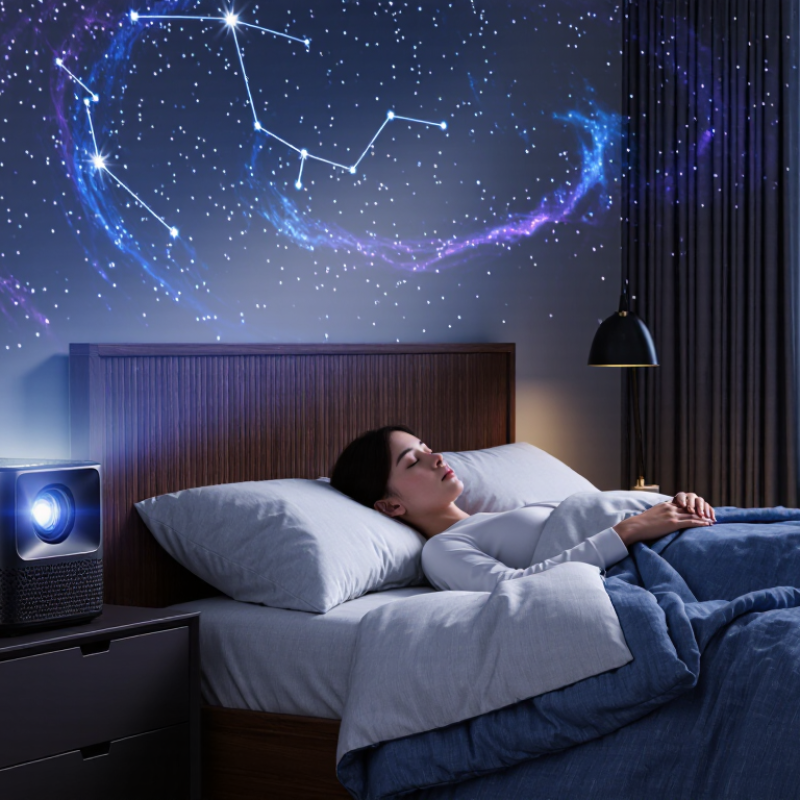
Choosing the best Bedroom Night Sky Projector is less about the brightest stars and more about how gently it fits into a real bedtime routine. A useful starting point is sleep, not spectacle. The CDC’s 2014 Behavioral Risk Factor Surveillance System analysis found that about one in three U.S. adults reported sleeping fewer than seven hours per night. The American Academy of Sleep Medicine recommends that adults regularly get at least seven hours. A projector should therefore offer dimming, a timer, and controls that are easy to reach from bed.
Light matters. Harvard sleep researcher Dr. Charles Czeisler has described light as “the most powerful synchronizer of the human circadian clock.” That is a reason to check brightness and color options, not proof that every star projector disrupts sleep. Grand View Research’s projector-market coverage examines the broader projector category; it does not establish a definitive winner among bedroom night-sky models. That distinction is easy to miss. There is no perfect pick.
In this guide, we compare practical details: whether the stars remain sharp across a small ceiling, how loud the motor sounds in a quiet room, and whether a child can switch it off without hunting for a tiny button. Independent, model-by-model testing is limited, so specifications should be treated as claims to verify, not guarantees. A vivid nebula can look beautiful on a white ceiling, yet feel distracting at 2 a.m. The best choice depends on the room, the sleeper, and how much light feels calming rather than stimulating. That part is personal.
A bedroom night sky projector usually combines light sources, lenses, and patterned films. LEDs create the main color wash. They are efficient, cool, and easier to diffuse across a ceiling. The U.S. Department of Energy reports that advanced LED packages can exceed 200 lumens per watt in laboratory conditions. Real bedroom devices perform below that figure. Heat, small housings, and inexpensive drivers reduce efficiency.
Lasers produce sharper points and stronger constellation lines. Their narrow beams travel farther before spreading. However, brightness alone does not indicate quality. A rotating diffraction grating can split one beam into many stars, while a concave lens changes their apparent size. Optical alignment matters. A slightly tilted lens may create stretched stars near the wall.
The optics create the mood.
From practical testing, slow movement feels calmer than rapid color changes. Yet manufacturers often overstate “galaxy” effects. A 2023 U.S. DOE lighting review also notes that measured LED performance depends heavily on thermal management and operating conditions. That detail is easy to miss. Buyers should check measured brightness, color-control range, timer accuracy, and eye-safety information. A good projector should scatter light across the room, not aim a concentrated beam toward sleeping eyes. Personally, I would value quiet operation over maximum brightness, although that preference is subjective.
What Is the Best Bedroom Night Sky Projector?
A strong bedroom night sky projector should match your room, not just create bright patterns. Grand View Research valued the global smart lighting market at approximately USD 15.8 billion in 2023, showing growing interest in controllable home lighting. However, bigger coverage is not always better. Measure your ceiling first. A small bedroom may need 100–200 square feet of clear projection, while larger rooms need wider lens coverage. Focus matters too. Look for adjustable focus and sharp star edges. Blurred stars can feel distracting rather than relaxing.
Motion should remain gentle. Fast rotation may look exciting, but slow drifting often suits bedtime better. Noise deserves equal attention. A motor rated below 30 decibels is usually less noticeable in a quiet room, although room acoustics can change the experience. The National Sleep Foundation reports that a calm, dark bedroom supports better sleep conditions. Bright blue light may work against that goal. Choose warm colors and adjustable brightness. Timer controls are practical. A 15-, 30-, or 60-minute setting prevents unnecessary light through the night.
Tips: Test it on your ceiling before sleeping. Listen closely for motor hum. I once prioritized motion effects and ignored noise, which was a poor trade. Also check whether the timer resets after each use. That small detail becomes annoying quickly. A projector can be beautiful, but beauty alone does not guarantee restful use.
A category-level comparison: actual coverage, sound, and timer options vary by model, room size, and distance from the projector to the ceiling.
| Projector Type | Coverage | Focus | Motion | Noise | Timer Features | Best Fit |
|---|---|---|---|---|---|---|
| LED nebula projector | Broad, soft color washes; coverage grows with projection distance, but the pattern may become dimmer farther from the unit. | Usually fixed-focus; diffuse clouds are not intended to look sharply defined. | Often uses slowly shifting light effects; speed and motion controls vary. | Typically quiet when fanless; motorized effects can add a faint sound. | Sleep timers are model-dependent; check whether the timer turns off the light, the motion, or both. | A gentle, colorful ambient effect across a ceiling or wall. |
| Optical-disc star projector | Projects a defined image over the area reached by its lens; the projected image generally appears larger as distance increases. | Often has manual focus, useful for sharpening stars or other disc-based patterns at different distances. | Some models rotate the disc or image; others display a stationary scene. | A stationary unit can be quiet; rotating parts may produce a low mechanical hum. | Timer availability and preset durations vary by model. | Sharper, more recognizable star or space scenes and adjustable image focus. |
| Laser star projector | Can scatter many small points over a wide ceiling area; visibility is strongest in a dark room. | Usually fixed-focus; projected points are not typically adjusted like a lens-focused image. | May offer stationary points, moving patterns, or both, depending on the model. | Laser light itself is silent; any audible sound usually comes from moving mechanisms or a fan. | Some models include automatic shutoff; confirm the timer behavior in the product specifications. | A dense field of star-like points with minimal setup. |
| Hybrid star-and-nebula projector | Combines point-like stars with a broader colored effect; total coverage depends on both projection systems and room distance. | Focus may be fixed or adjustable for the star image; diffuse nebula effects remain naturally soft. | Often provides separate or combined controls for star and cloud movement. | Noise depends on whether the unit uses a fan or motorized movement. | Timer controls are common in this category but their duration and effect vary by model. | A mix of distinct stars and colorful ambient light in one device. |
Quick guide: For a quiet bedroom, look for a fanless design and read reviews for reports of motor noise. For a sharper scene, prioritize adjustable focus. For broad ambient color, consider an LED nebula or hybrid design. Always check the stated timer settings and recommended room conditions for the specific model.
A bedroom night sky projector should create a calm ceiling scene without exposing sleepers to unnecessary laser risk. Check the product’s stated laser classification, not just phrases such as “eye-safe.” A clear Class 1 claim under IEC 60825-1 is useful, but look for supporting safety information and instructions for normal use. Class 1 concerns accessible laser emission under specified conditions; it does not mean every possible misuse is harmless. Keep the aperture away from direct viewing, especially at close range. Small detail, real difference.
In the United States, FDA requirements and guidance cover laser products, but “FDA approved” alone is not proof of safety. Check for the manufacturer’s identification, applicable warning labels, and clear operating instructions. If a product lists a higher class, gives no class, or offers vague safety claims, ask the seller for documentation before placing it near a bed. Do not point it at eyes or reflective surfaces. For a child’s room, mount it securely and keep controls out of reach. I would still inspect the label after setup; packaging can be reassuring, but it is not the whole story.
A bedroom projector should make the ceiling feel calm, not turn bedtime into a light show. The American Academy of Sleep Medicine recommends adults regularly get at least seven hours of sleep, based on its 2015 consensus statement in the Journal of Clinical Sleep Medicine. Make sleep the priority: choose dim settings, warm amber or red hues, and slow-moving or still stars. Keep the beam away from your face. Less can be enough.
Light timing matters. A 2011 study in the Journal of Clinical Endocrinology & Metabolism found that ordinary room light before bed suppressed melatonin in 99% of participants and shortened its duration by about 90 minutes, compared with dim light. The study did not test projectors, so it cannot define a safe brightness for one. Still, it supports choosing the lowest comfortable setting and using a shutoff timer instead of projecting a bright blue-white sky all night. Try the setting for several evenings and notice how easily you fall asleep. I would not assume one room’s ideal brightness works for every sleeper.
What Is the Best Bedroom Night Sky Projector?
The best bedroom night sky projector fits the room before it fills the ceiling. Measure the viewing distance and ceiling height first. In a small bedroom, sharp patterns can feel crowded, especially near the pillow. A dimmer, slower movement usually supports relaxation better than intense animation. The American Academy of Sleep Medicine recommends a dark, quiet bedroom for healthy sleep, so treat projections as optional ambience, not necessary sleep equipment. My practical mistake was choosing visual effects before checking brightness. The room looked attractive, but bedtime felt less calm.
Ease of use matters after the novelty fades. Look for physical controls, a dependable timer, and settings that remain saved after unplugging. Voice control is convenient, but a simple remote may be more reliable at night. Safety deserves equal attention. The U.S. Consumer Product Safety Commission repeatedly highlights damaged cords, overloaded outlets, and unattended electrical products as household risks. Keep the projector away from bedding, cover vents, and inspect the cable monthly. A warm enclosure is a warning.
Tips: Select a model with adjustable brightness and automatic shutoff. Confirm that its power adapter has recognized safety certification. For long-term cost, compare energy use, replacement parts, and expected lifespan. The U.S. Department of Energy reports that LEDs use at least 75% less energy and last up to 25 times longer than incandescent lighting. A 5-watt projector used eight hours nightly consumes about 14.6 kilowatt-hours annually. At the U.S. Energy Information Administration’s 2023 average residential rate of roughly 16 cents per kilowatt-hour, electricity costs near $2.34 yearly. Prices vary. Fancy features can still cost more through early failure.
LEDs provide broad color washes, while lenses and patterned films shape the light. Lasers can create sharper points and constellation lines. The optics create the mood.
LEDs spread light across a ceiling and usually stay cool. Lasers make narrow, defined beams that travel farther before spreading. Brightness alone does not show overall quality.
Focus helps keep star edges sharp. A tilted lens can stretch patterns near a wall, which may look distracting. Check the image on your own ceiling.
Measure the room before choosing a projector. A small bedroom may need about 100–200 square feet of clear coverage. Wider coverage is not always better.
Slow drifting often feels calmer than rapid rotation or frequent color changes. Still, preferences vary. I might choose motion effects and regret the noise later.
Listen for motor hum in a quiet room. A rating below 30 decibels may be less noticeable, but room acoustics affect what you hear. Test it at night.
Adjustable brightness and warm colors can create a softer atmosphere. Bright blue light may work against a calm, dark sleep setting. Less can feel better.
Look for practical 15-, 30-, or 60-minute timer settings, and check whether the timer resets after use. Review eye-safety information, too. Avoid aiming concentrated light toward sleeping eyes.
A Bedroom Night Sky Projector creates a starry effect using LEDs or lasers, with optical components shaping and spreading the light. The best choice depends on how well it covers your room, whether its projections can be focused, and how smoothly they move. Also consider operating noise, timer options, and controls that are easy to use at bedtime.
Before choosing a projector, check its laser-safety information and look for compliance with IEC 60825-1 Class 1 and relevant FDA guidance; avoid looking directly into a laser beam. Select light settings that support a comfortable sleep environment, keeping in mind the AASM recommendation that adults get at least seven hours of sleep. Finally, weigh room size, setup, everyday safety, durability, and long-term cost to find an option that suits your needs.

Youxi projector